Why Euclid Matters
In 2024, DESI (Dark Energy Spectroscopic Instrument) reported that "dark energy" may be changing over time. If true, it would overturn the cosmological constant (Λ) and reshape modern physics. Mode Identity Theory says the change is an illusion: Λ is fixed by the geometry of the universe, and what looks like evolution is the observer's phase position on a standing wave.
MIT predicts a specific shape (cosine, not linear), a specific zero-crossing (z = 0.663), and a specific constraint (Λ itself does not change). All values were deposited on Zenodo and MIT has no knobs to adjust. Euclid's independent measurement will either end MIT, ΛCDM, or both. Full stop.
Registration
All values were pre-registered on Zenodo in January 2026, months before DR1. The DESI DR2 analysis is a consistency check against already-public data. Euclid is the blind test.
δ is fixed by registration. ε is calibrated from the DES-SN5YR + Planck + SDSS BAO combination (Abbott et al. 2024), which contains zero DESI data and zero Euclid data. Both values precede the data they are tested against.
Predictions
The mechanism
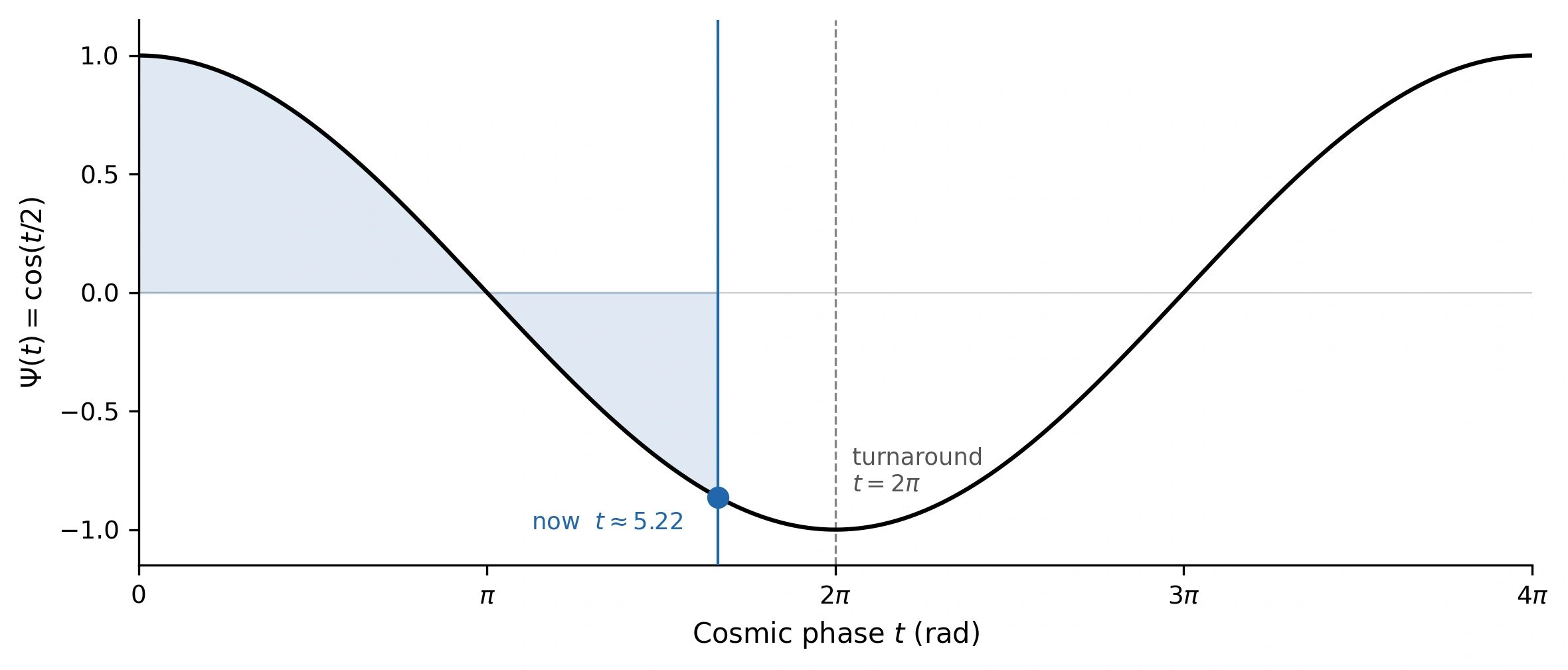
MIT holds Λ fixed by topology. The cosmic standing wave Ψ = cos(t/2) modulates the dark energy surface mode, leaving matter and radiation untouched. When observers fit distance data using fluid-based models, the phase structure leaks into apparent w(z) evolution.
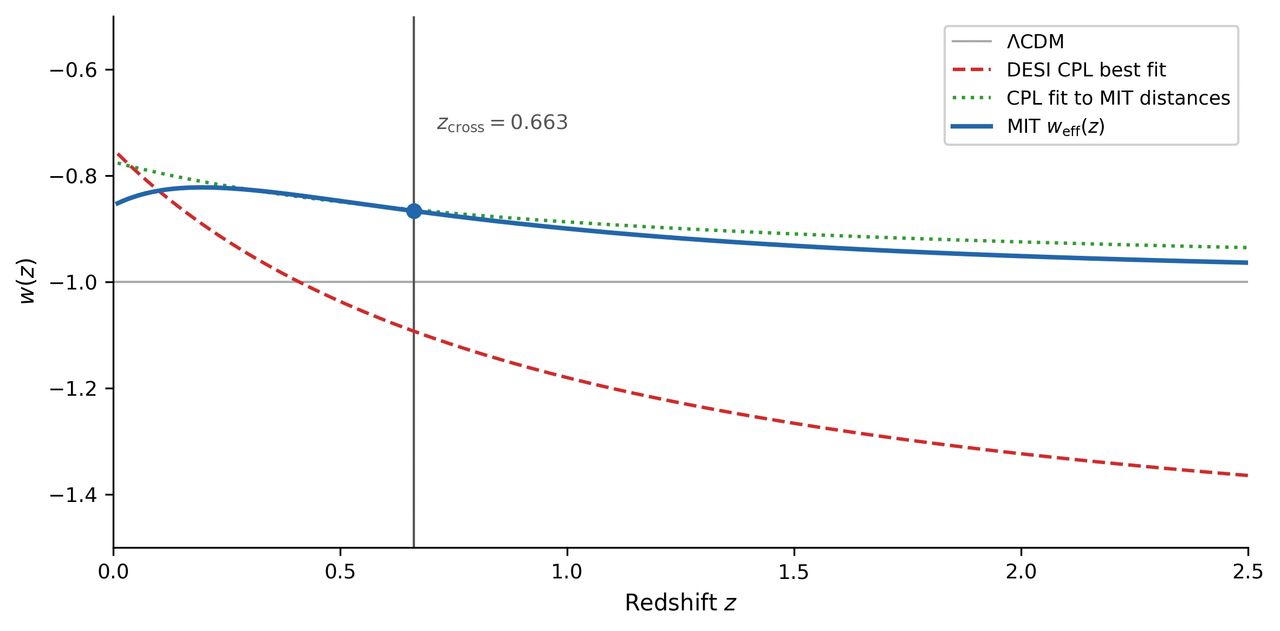
The modulation is invisible to the CMB by construction: ΩΛbare/E2(z*) ~ 10−9 at recombination. It becomes observable only at low redshift, where ΩΛ dominates the energy budget. The deviation from ΛCDM peaks at ~4.6% near zcross = 0.66, falling to zero at z = 0 (normalization) and z ≫ 1 (matter dominance).
CPL uses two free parameters (w0, wa) to fit the shape. MIT uses zero free parameters for the shape: δ is fixed, ε is calibrated externally, and the cosine form follows from the axioms. A purely linear w(z) at high precision would falsify the phase modulation signature.
DESI DR2 consistency check
The DESI analysis uses already-public data. It is a consistency check, confirming the modulation template is compatible with current BAO measurements. It is not the blind test.
| Model | Parameters | χ²BAO | χ²total | ΔAIC vs ΛCDM |
|---|---|---|---|---|
| ΛCDM | 2 | 13.54 | 1419.58 | 0 |
| MIT (ε = 0.255) | 2 | 11.21 | 1417.45 | −2.1 |
| CPL | 4 | 8.58 | 1411.55 | −4.0 |
Combined analysis: DESI DR2 BAO (13 observables, 7 bins) + Pantheon+ (~1590 SNe) + Planck-calibrated H0rd prior. MIT improves on ΛCDM at the same parameter count. Profiling ε yields Δχ² = −7.9 at ε = 0.16 (ΔAIC = −5.9 at k = 3).
Timeline
What Euclid DR1 delivers
DR1 contains the first year of survey data: ~2,300 square degrees of sky, plus accumulated deep field passes. This is the first Euclid release with cosmology results.
| DR1 product | MIT relevance | What to watch |
|---|---|---|
| Weak lensing (cosmic shear) | Constrains Ωm, w0 independently of BAO | Does the shear power spectrum prefer w0 > −1? |
| Galaxy clustering (spectroscopic z) | BAO standard ruler, independent of DESI | New BAO measurements across Euclid's redshift bins |
| Photometric redshifts | Galaxy distribution, tomographic bins | Precision at z ~ 0.5–0.8 (near zcross) |
| Strong lensing (~7,000 candidates) | Geometry probe via Dd/Ds ratios | Independent distance ratios through the zcross window |
| Higher-order WL statistics | 2.5× more sensitive to w0 than 2-point | Sensitive to the shape of w(z), not just the value |
| Galaxy cluster abundance | σ8, structure growth rate | Growth vs. expansion history consistency |
Euclid's weak lensing and galaxy clustering are complementary to DESI's BAO. They constrain the same underlying physics through different observables and different systematics. Separate instrument, separate team, separate data.
Papers
| Paper | Reference | Status |
|---|---|---|
| Λ Constant, w Evolving | Zenodo | Registered |
| Mode Identity Theory (Engine) | Zenodo | Registered |
| Λ Ground Mode of the Cosmic Boundary | Zenodo | Registered |
| Λ Constant, a0 Evolving | Zenodo | Registered |
| Euclid DR1 results | TBD | Awaiting |