Why Euclid Matters
In 2024, DESI reported that "dark energy" may be changing over time. If true, it would overturn the cosmological constant (Λ) and reshape modern physics. Mode Identity Theory says Λ is fixed by the geometry of the universe: the ground eigenvalue of the Möbius surface, topologically protected at the antinode of the mode spectrum. What standard templates read as dynamical dark energy is the observer's phase position on a standing wave.
Three predictions separate the framework from alternatives: the MOND acceleration scale a0(z) tracks H(z) at every epoch, Λ remains constant, and no dark matter particle will ever be found. All values were deposited on Zenodo before data release. Euclid's independent measurement will either end MIT, ΛCDM, or both. Full stop.
Registration
All values were pre-registered on Zenodo before DR1. The DESI DR2 analysis is a consistency check against already-public data. Euclid is the blind test.
The three primary predictions follow from the topology. The phase parameter s0 controls the distance-redshift relation and is constrained by Pantheon+ and DESI DR2 BAO at Δχ² = +0.11 relative to flat ΛCDM.
Predictions
The Mechanism
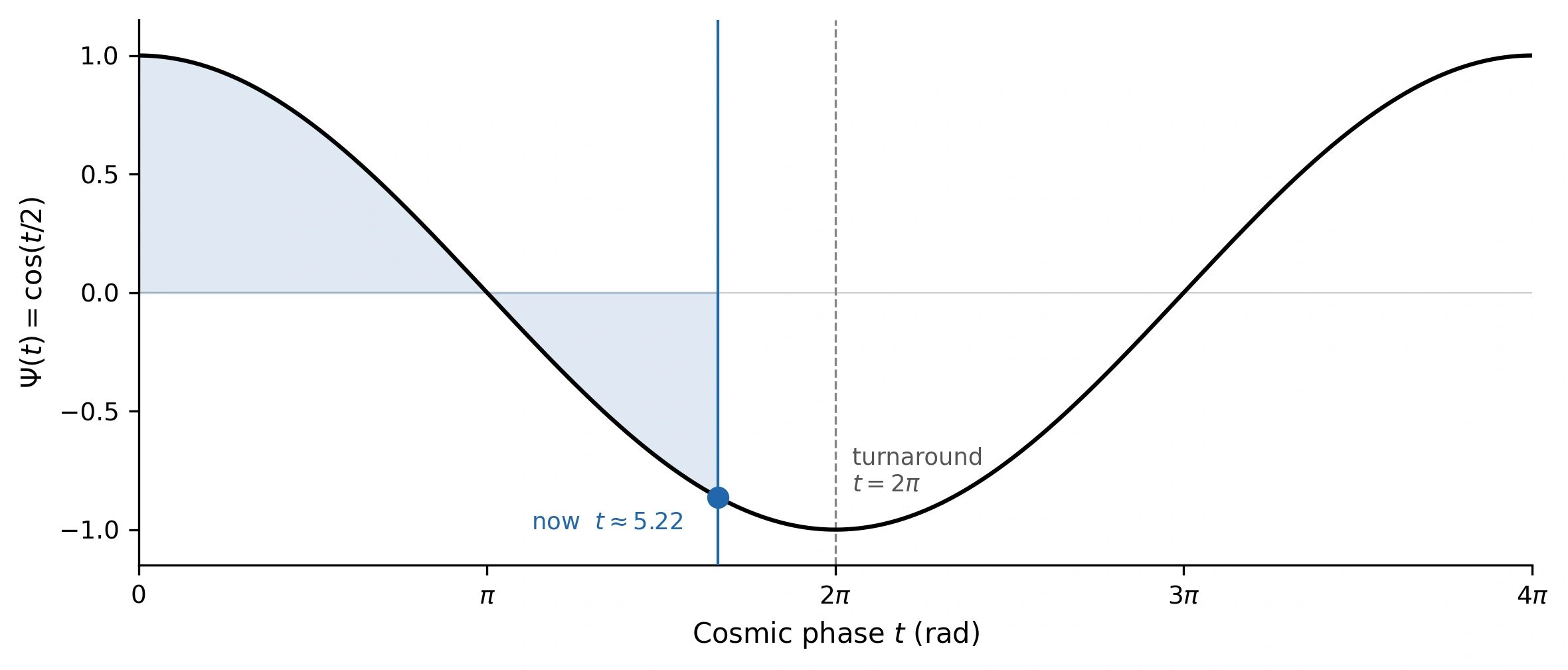
MIT holds Λ fixed by topology: the ground eigenvalue of the Möbius surface, Λtop = 2/R², converted to the observed value by the Gauss equation (factor 3/2). The cosmos is a static three-sphere. Redshift is phase evolution on the temporal edge, governed by the Waltz clock dt/dτ = S−1/2, where S = sin(t/2).
The negative (1+z)1 term is the distinctive signature: absent from the four canonical FLRW components (radiation, matter, curvature, cosmological constant), it arises from the bounded phase parameterization. Its coefficient β is tied to the single phase parameter s0 = sin(tnow/2). Standard two-parameter templates (CPL, BA, JBP) absorb this curvature as apparent phantom crossings through w = −1, a template artifact established analytically in the companion dark energy analysis.
a0/cH = 0.184 is a ratio of Fibonacci well positions. Λ = 3/R² is a derived coefficient. The null DM prediction follows from the manifold hierarchy. Euclid probes all three through independent channels with independent systematics.
DESI DR2 Consistency Check
Joint fits to Pantheon+ (1701 SNe Ia) and DESI DR2 BAO (13 data points) confirm the phase-clock relation is indistinguishable from flat ΛCDM at current precision.
| Model | Free parameters | χ²min | Δχ² vs ΛCDM |
|---|---|---|---|
| ΛCDM | 3 (Ωm, H0rd, MB) | 1772.5 | 0 |
| MIT phase-clock | 3 (s0, H0rd, MB) | 1772.6 | +0.11 |
Phase parameter: s0 < 0.19 (95% CL, flat prior). ΩΛ = 0.685 fixed by topology. The two distance-redshift relations are indistinguishable at current precision. The ΛCDM limit is recovered exactly at s0 = 0.
Timeline
What Euclid DR1 Delivers
DR1 contains the first year of survey data: ~2,300 square degrees of sky, plus accumulated deep field passes. This is the first Euclid release with cosmology results.
| DR1 product | MIT relevance | What to watch |
|---|---|---|
| Weak lensing (cosmic shear) | Rotation curves across redshift bins probe a0(z) | Does a0 scale with H(z) or remain constant? |
| Galaxy clustering (spectroscopic z) | BAO standard ruler, independent of DESI | Independent BAO measurements across Euclid's redshift bins |
| Photometric redshifts | Galaxy distribution, tomographic bins | Distance-redshift relation consistent with constant Λ? |
| Strong lensing (~7,000 candidates) | Geometry probe via Dd/Ds ratios | Independent distance ratios testing Λ constancy |
| Lensing mass vs. clustering mass | Tests whether "dark matter" is particles or geometry | Non-gravitational signal in the mass comparison? |
| Galaxy cluster abundance | σ8, structure growth rate | Growth vs. phase-clock history consistency |
Euclid's weak lensing and galaxy clustering are complementary to DESI's BAO. They constrain the same underlying physics through different observables and different systematics. Separate instrument, separate team, separate data.
Papers
| Paper | Reference | Status |
|---|---|---|
| Λ Constant, w Evolving | Zenodo | Registered |
| Mode Identity Theory (Engine) | Zenodo | Registered |
| Λ Ground Mode of the Cosmic Boundary | Zenodo | Registered |
| Λ Constant, a0 Evolving | Zenodo | Registered |
| Euclid DR1 results | TBD | Awaiting |